
- Home
- The Invisible Gradient: Why Oxygen Distribution Might Be the Real Difference Between Good and Great Trichoderma

Aditi Bijalwan
Co-founder at Agrilogy Bioscience Private Limited
The green carpet on our SSF trays is beautiful, no doubt. But if you look past the colour and focus on what the fungus is actually breathing, a far more interesting story unfolds.
We talk a lot about moisture, temperature, and substrate composition. But there is another parameter—silent, invisible, and arguably more decisive—that separates a mediocre batch from a biochemically potent one. That parameter is oxygen.
And here is the twist: how oxygen reaches Trichoderma in Solid-State Fermentation (SSF) is fundamentally different from how it works in Submerged Fermentation (SmF). Understanding this difference isn't just academic trivia. It explains why SSF produces spores that are biochemically primed for the monsoon—and why the oxygen gradient within our trays might be the secret ingredient we have been overlooking.
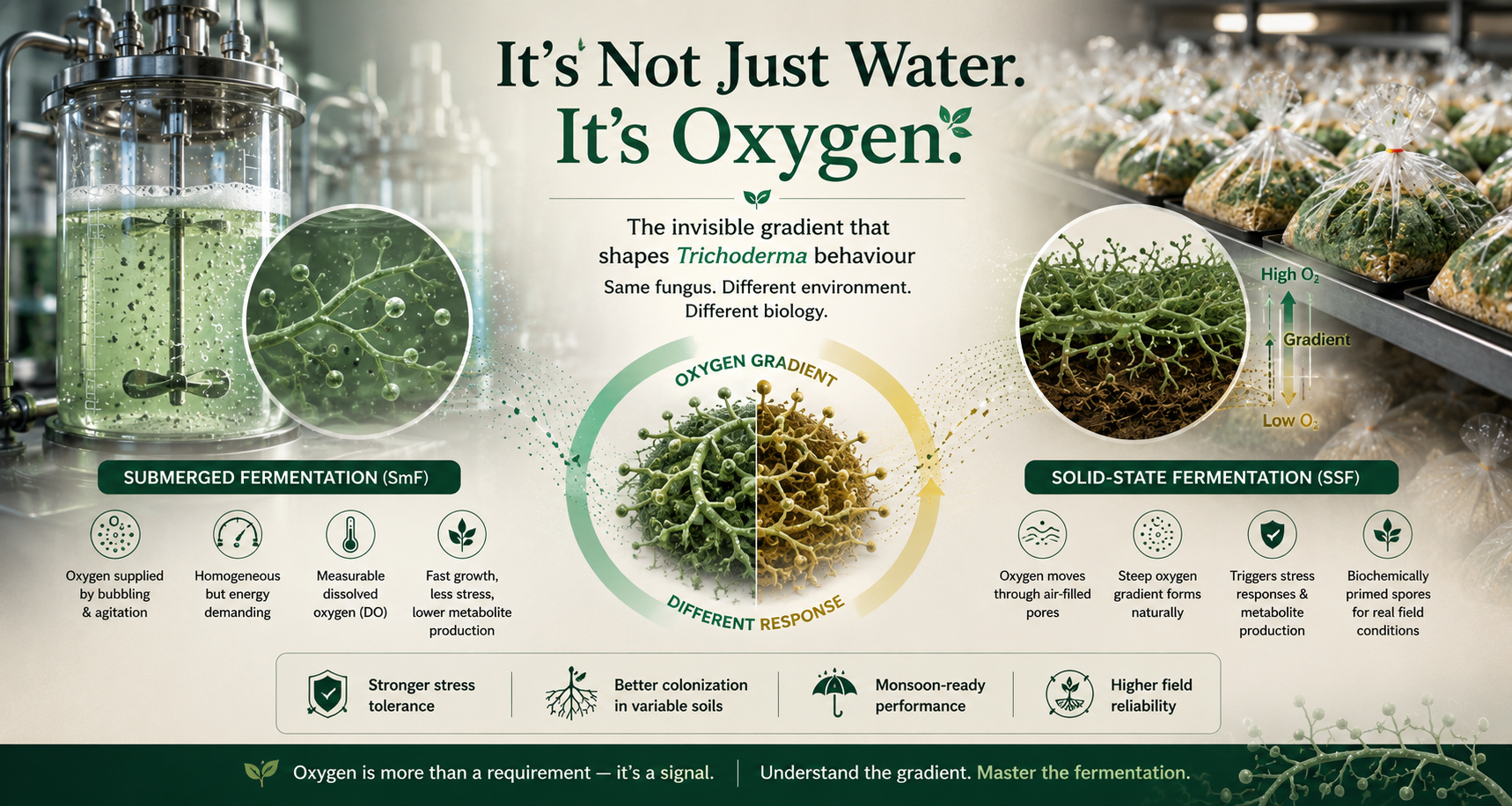
The SmF Oxygen Reality: Homogeneous but Demanding
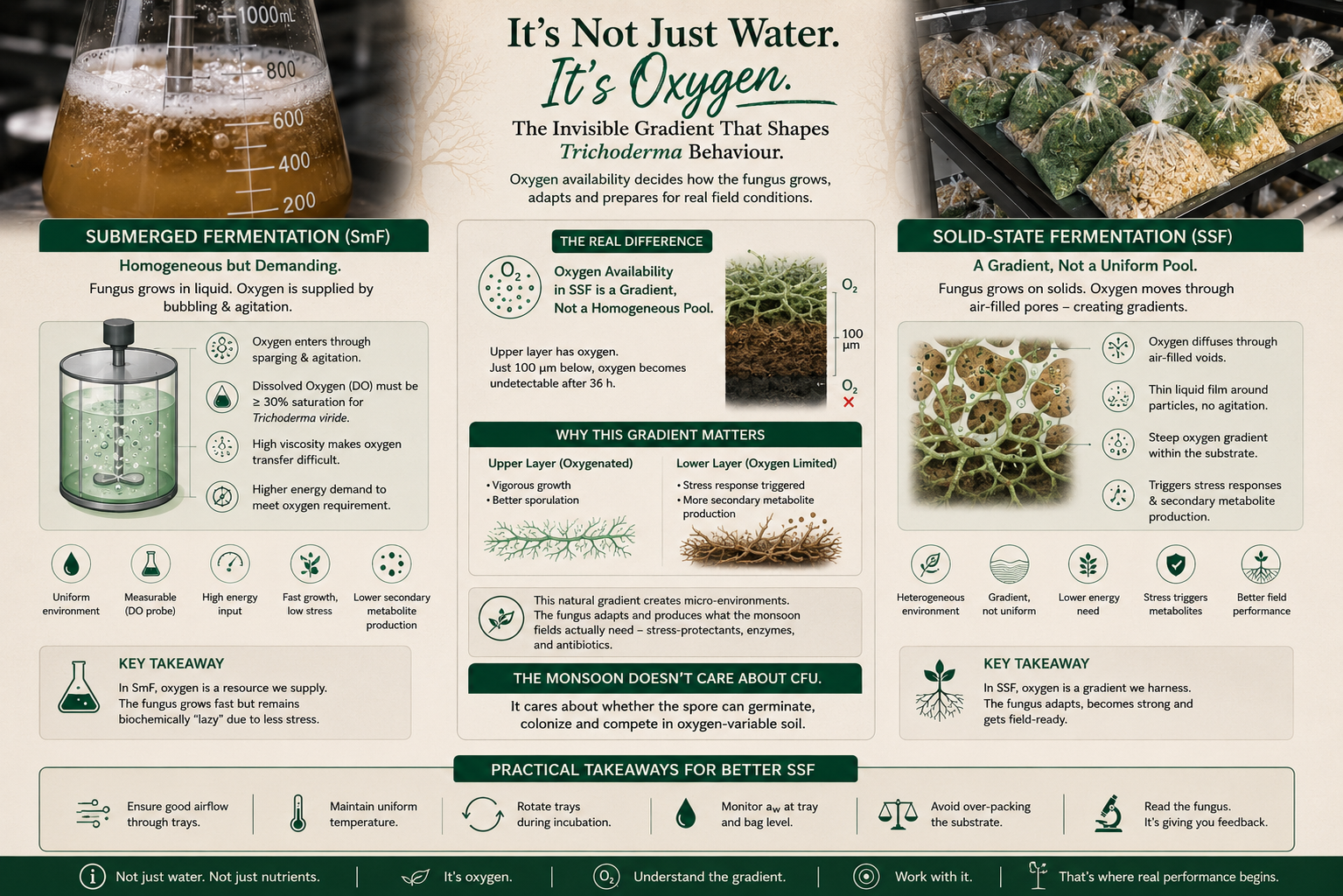
In submerged fermentation, Trichoderma grows in a liquid broth—water, sugars, nutrients, all mixed together. Oxygen enters the system through sparging (bubbling air) and mechanical agitation. The gas bubbles diffuse into the liquid, dissolve at the gas-liquid interface, and then travel through the bulk liquid to reach the fungus.
This setup is relatively predictable. Dissolved oxygen (DO) concentration can be measured with a probe. The volumetric oxygen mass transfer coefficient is a standard parameter that engineers track closely.
For Trichoderma viride, maintaining dissolved oxygen at or above 30% saturation is critical for growth and conidia production. Drop below that, and the fungus struggles.
But here is the catch: Trichoderma is a filamentous fungus. As it grows, it develops hyphae, creating a highly viscous, shear-thinning medium. This viscosity makes oxygen transfer increasingly difficult. To keep up with the oxygen demand, agitation and aeration requirements escalate significantly, especially at higher biomass concentrations. The system becomes energy-intensive and technically demanding.
The SSF Oxygen Reality: A Gradient, Not a Homogeneous Pool
Now, shift your gaze to our SSF trays. The fungus grows on the surface of solid particles—rice bran, wheat straw—surrounded by a thin liquid film and air-filled void spaces. The water content is low, typically around 55–60%. There is no bulk liquid. There are no bubbles. There is no mechanical agitation.
So, how does oxygen reach the fungus?
Here is the counterintuitive part: oxygen mass transfer is actually more efficient in SSF than in SmF—on paper, at least. Why? Because the fungus is in close contact with the gaseous oxygen that flows through the void spaces between solid particles. The higher area-to-volume ratio of the solid matrix facilitates oxygen transfer. In theory, oxygen is everywhere.
But "everywhere" is not the same as "available."
In reality, SSF creates steep oxygen concentration gradients. The fungal mat itself develops into layers—an upper layer of sparse aerial hyphae with gas-filled pores, and a dense bottom layer with liquid-filled pores. Oxygen microelectrode measurements have shown that while the upper aerial layer remains oxygenated, oxygen becomes undetectable just 100 micrometres below the gas-liquid interface after 36 hours of cultivation.
Let that sink in. One hundred micrometres. That is thinner than a human hair. And yet, oxygen cannot penetrate beyond that depth.
The consequence? The fungus in the deeper, wetter layers experiences oxygen depletion. And when oxygen is limited, Trichoderma viride shifts its metabolism. It switches to a fermentative pathway, producing ethanol, succinate, and other carboxylic acids. The appearance of secondary metabolites is directly modified by oxygen availability.
Why This Gradient Matters for Your SSF Trays
This oxygen gradient is not a problem to be solved. It is a feature—and perhaps the very reason SSF produces such potent biocontrol agents.
The gradient creates microenvironments within a single tray. The upper layers, bathed in oxygen, support vigorous growth and sporulation. The deeper layers, oxygen-limited, trigger stress responses that upregulate secondary metabolite production. The fungus is not a uniform mass; it is a heterogeneous population responding to local conditions. And heterogeneity, in this context, might be a good thing.
The Practical Takeaway
- In SmF, oxygen is a resource you must constantly supply. It is homogeneous, measurable, and energy-intensive to maintain. The fungus grows fast but biochemically "lazy" because stress is minimised.
- In SSF, oxygen is a gradient. It is heterogeneous, self-organising, and creates natural stress zones within the substrate. The fungus adapts—producing stress-protectants, antibiotics, and enzymes in response to local oxygen depletion.
The monsoon doesn't care about your CFU count. It cares about whether the spore can germinate, colonise, and compete in oxygen-variable soil conditions. And that readiness? It is forged in the oxygen gradients of your SSF trays.
The question that lingers:
Are we still treating oxygen as a simple "supply" problem—or are we ready to embrace the gradient as a deliberate tool for biochemical conditioning?
Our trays have been telling us this story all along. It is time we started listening.
Comments (0)
No comments yet. Be the first to comment!
Search Blogs
Recent Blogs
The Biology of Water Activity
August 7, 2026
What the Green on Our Trays Is Really Telling Us
July 29, 2026
Leave a Comment