
- Home
- Beyond the Root: How Mycorrhizal Fungi Lead a Microbial Network to Healthier Soil

Aditi Bijalwan
Co-founder at Agrilogy Bioscience Private Limited
Mycorrhizal fungi are the cornerstone of the rhizosphere's "Wood Wide Web," coordinating with bacteria and protists in a powerful nutrient exchange. Learn how this partnership is key to plant health, soil carbon storage, and sustainable farming.
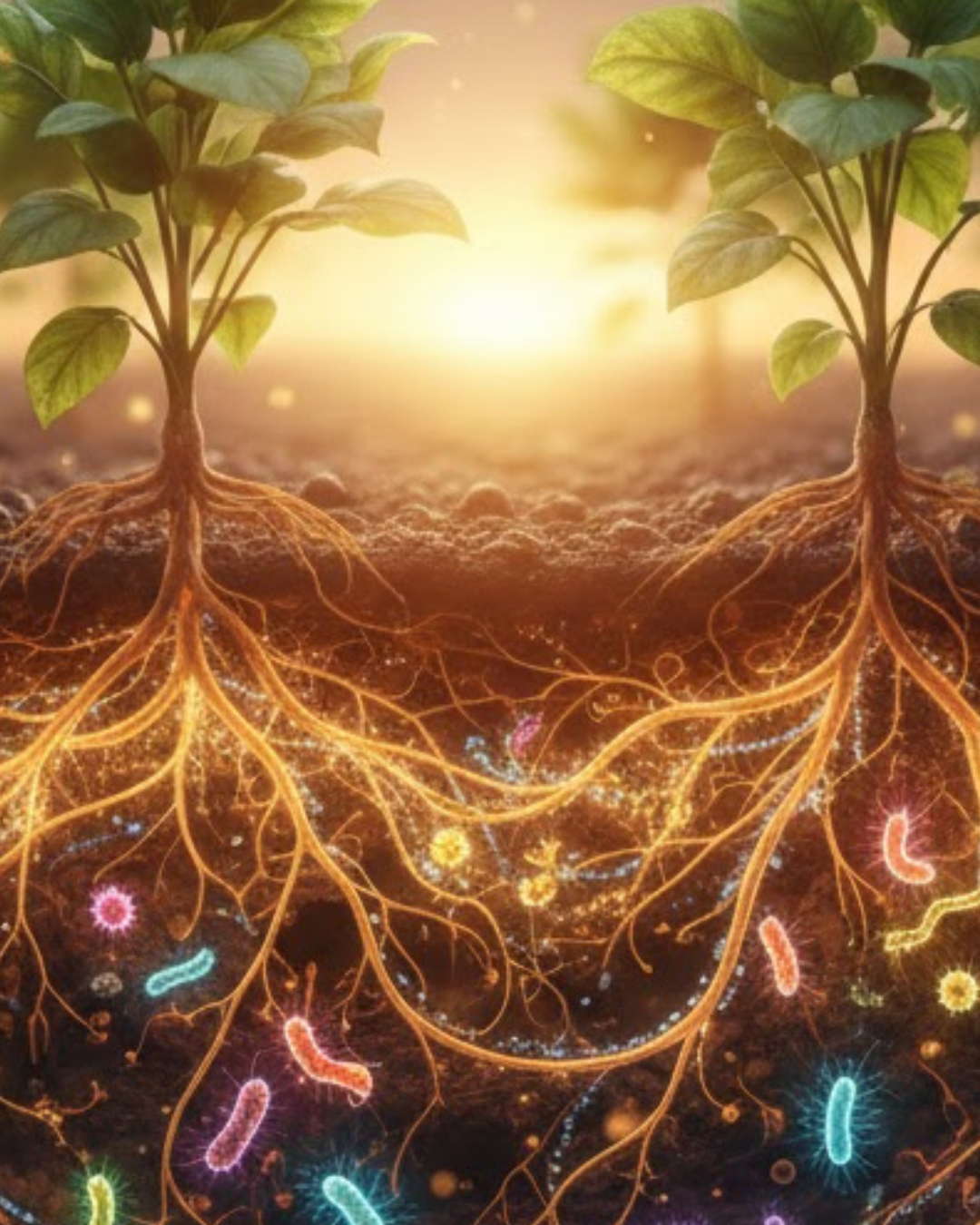
Beneath every thriving plant lies a hidden economy—one where currencies of carbon, nitrogen, and nutrients flow through a living network so sophisticated it makes our digital world seem simple.
We often hear about mycorrhizal fungi, nature's famous root partners, but they are just one actor in a much larger ensemble.
Welcome to the rhizosphere: the bustling, millimeter-thin zone around plant roots where fungi, bacteria, protists, and countless microbes don't just coexist—they collaborate with a precision that sustains entire ecosystems, builds climate resilience, and even powers a new kind of economy: the soil carbon market.
The Rhizosphere: Not Just Dirt, but a Living Marketplace
Picture the soil around a root not as dirt, but as a vibrant, microscopic city. The root is the central plaza, exuding root exudates—a rich cocktail of sugars, acids, and compounds that act like an open invitation and currency. This is where the collaboration begins.
The Key Players and Their Roles:
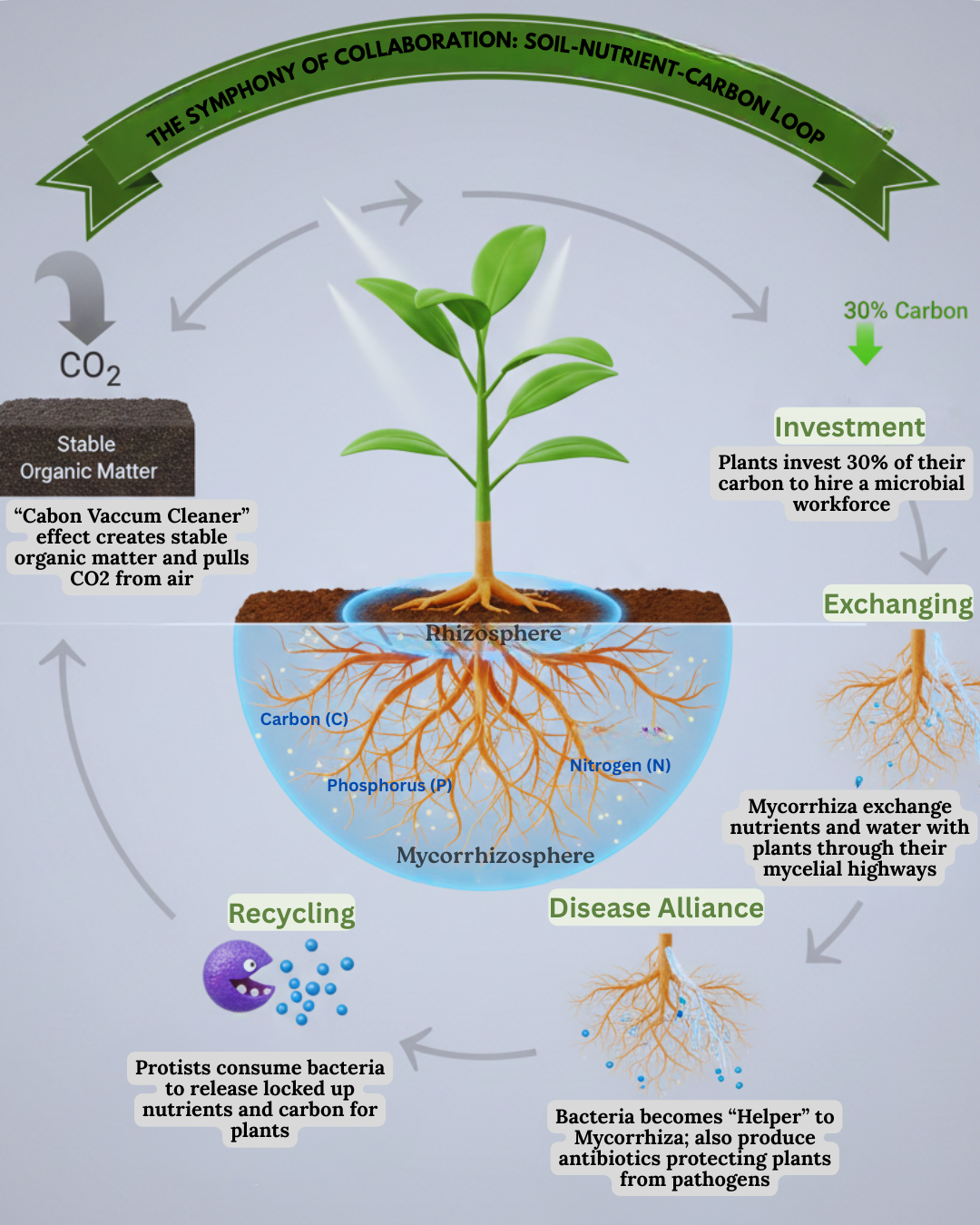
- Plant Roots: The "Bankers" and architects. They invest up to 30% of their photosynthesized carbon into the soil to hire their microbial workforce.
- Mycorrhizal Fungi: The "Distribution Network." Their vast mycelial highways transport water and nutrients (like phosphorus) to plants in exchange for carbon. They connect entire plant communities in a "Wood Wide Web."
- Bacteria: The "Specialized Processors." They fix atmospheric nitrogen, solubilize minerals, decompose organic matter, and produce growth-promoting hormones and natural antibiotics. Some, like rhizobia, form direct partnerships with legumes.
- Protists: The "Regulators and Recyclers." These microscopic predators graze on bacteria, releasing locked-up nitrogen and other nutrients in a process called the "microbial loop." They keep the bacterial community productive and diverse.
The Symphony of Collaboration: How the Web Functions?
This isn't a collection of independent organisms; it's a tightly integrated system where each member's survival boosts the others.
1. The Nutrient Exchange Cycle:
The plant pays fungi and bacteria with carbon (sugars). Bacteria process raw materials. Protists then consume bacteria, releasing plant-ready nutrients right onto the fungal highways. Fungi deliver these nutrients back to the plant. The plant, now healthier, photosynthesizes more, funding the next cycle.
2. The Defense Alliance:
A diverse rhizosphere microbiome is a plant's best immune system. Bacteria produce antibiotics. Mycorrhizal fungi form a physical barrier on roots. Predatory protists and nematodes consume pathogenic fungi and bacteria. Together, they "crowd out" disease.
3. The Soil Structure Brigade:
Fungal hyphae weave through soil particles, binding them into stable aggregates. Bacteria produce sticky glues (polysaccharides). This creates pore spaces for air, water, and root growth—transforming compacted dirt into resilient, spongy soil.
How This Tiny World Helps Our Big World (Including Climate!) ?
This teamwork doesn’t just help plants—it can pull carbon out of the air and lock it safely in the soil. Here’s how:
- Plants take CO₂ from the air.
- They send carbon down to their roots to feed microbes.
- Microbes use some carbon, but a lot of it gets stored in the soil as stable organic matter (thanks to fungal networks and microbial “leftovers”).
- This process makes soil richer and acts like a carbon vacuum cleaner for the atmosphere.
From Collaboration to Credits:
Regenerative agricultural practices (no-till, cover cropping, diverse rotations, compost) explicitly aim to nurture this rhizosphere web. By doing so, farmers can:
- Increase the amount of carbon sequestered in their soil.
- Have this sequestration measured and verified by third parties.
- Earn soil carbon credits sold to companies or governments to offset their emissions.
This creates a powerful financial incentive to farm in a way that supports the very microbial collaborations that underpin ecosystem health. It’s a market-driven revolution rooted in biology.
How to Nurture the Web: A Guide for Gardeners, Farmers?
You can’t create this web by force, but you can create the conditions for it to flourish.
Do`s:
- Feed the Network: Add diverse organic matter (compost, mulch, cover crop roots). This is the universal fuel.
- Diversify: Plant polycultures. Different root exudates support different microbes, strengthening the entire web.
- Minimize Disturbance: Reduce or eliminate tillage. It destroys fungal networks and soil aggregates.
- Keep it Covered: Bare soil is a dead zone. Living roots and mulch maintain the habitat.
Avoid:
- Broad-Spectrum Chemicals: Pesticides and fungicides are often "weapons of mass destruction" for this delicate community.
- Synthetic Nitrogen Overload: It can shut down natural nitrogen-fixing partnerships and acidify the soil.
- Compaction: It destroys the pore spaces that are the microbial habitat.
The Big Picture
Mycorrhizal fungi are great, but the real power is in the teamwork—the whole web of life in the rhizosphere. When we support this teamwork, we get:
- Healthier plants with less work
- Better soil that holds water
- Fewer pests and diseases
- More nutritious food
- A real, natural solution to climate change
Good gardening—and good farming—is less about controlling nature, and more about supporting the partnerships that already exist. When we feed the life in the soil, the soil feeds us back, in more ways than one.
Comments (0)
No comments yet. Be the first to comment!
Search Blogs
Recent Blogs
The Biology of Water Activity
August 7, 2026
What the Green on Our Trays Is Really Telling Us
July 29, 2026
Leave a Comment