
- Home
- Metarhizium Entomopathogenesis: A Well-Orchestrated Action of Enzymes and Toxins

Aditi Bijalwan
Co-founder at Agrilogy Bioscience Private Limited
When we talk about entomopathogenic fungi, Metarhizium anisopliae consistently stands out as one of the most efficient and widely adopted biological control agents. Its success does not come from a single lethal factor, but from a well-coordinated biological strategy where enzymes and toxins act in sequence to overwhelm the insect host.
This orchestration is what makes Metarhizium anisopliae a reliable entomopathogenic solution in modern agriculture.
Contact-Based Infection: The Strength of Entomopathogenic Fungi
Unlike many conventional insecticides, Metarhizium anisopliae does not need to be ingested. As an entomopathogenic fungus, it initiates infection simply through contact with the insect cuticle.
Once the spores land on a susceptible insect, the entomopathogenic process begins immediately. The insect cuticle, which acts as the first line of defense, becomes the primary target.
This contact-based mode of action is one of the major advantages of entomopathogenic fungi, especially for soil-dwelling and surface-active pests.
Enzymes: The Entry Tools of Metarhizium anisopliae
The insect cuticle is a complex structure composed mainly of lipids, proteins, and chitin. Metarhizium anisopliae produces a specific set of enzymes to degrade each of these components in a coordinated manner.
- Lipases break down the waxy lipid layer, improving fungal adhesion and initiating nutrient release.
- Proteases degrade structural proteins, softening the cuticle and weakening its mechanical strength.
- Chitinases attack chitin, the backbone of the insect exoskeleton, creating physical entry points for fungal penetration.
This enzymatic synergy is a defining feature of entomopathogenic fungi. Rather than forcing entry, Metarhizium anisopliae gradually dismantles the insect’s protective armor.
Inside the Host: Entomopathogenic Colonization
Once the cuticle barrier is breached, Metarhizium anisopliae enters the insect hemolymph and rapidly spreads throughout the body. At this stage, the entomopathogenic strategy shifts from penetration to systemic colonization.
The fungus produces enzymes such as trehalase, which breaks down trehalose—the main energy source of insects. This results in:
- Energy depletion
- Reduced movement
- Feeding inhibition
From the host’s perspective, basic physiological functions begin to fail, even before visible death occurs.
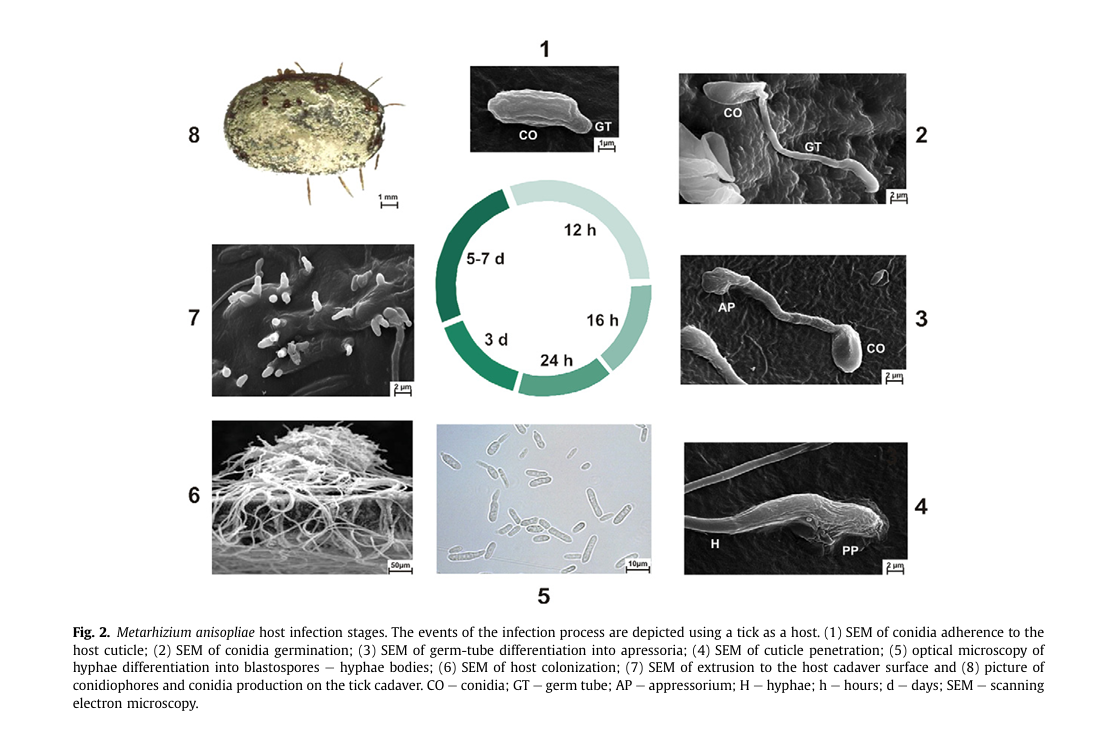
Picture Courtesy: Metarhizium anisopliae enzymes and toxins
Toxins: Accelerating Insect Mortality
Alongside enzymatic activity, Metarhizium anisopliae produces destruxins, a group of toxins that play a critical role in entomopathogenesis.
Destruxins do not act as instant poisons. Instead, they:
- Suppress the insect immune system
- Damage muscles and nervous coordination
- Disrupt excretory functions
A key outcome of destruxin activity is reduced insect mobility. Insects often attempt to escape infection by seeking warmer environments, but toxin-induced weakness prevents this behavioral defense. This gives the entomopathogenic fungus a decisive advantage.
Why This Orchestration Matters?
The effectiveness of Metarhizium anisopliae lies in the sequence and coordination of its actions:
- Enzymes enable attachment and penetration
- Enzymes and nutrient depletion weaken the host
- Toxins suppress immunity and movement
- Entomopathogenic colonization leads to death and sporulation
This multi-layered entomopathogenic mechanism explains why Metarhizium anisopliae performs consistently in the field and why resistance development is far less likely compared to chemical insecticides.
Conclusion
Metarhizium anisopliae represents the true strength of entomopathogenic biology—a system where enzymes and toxins work in harmony rather than isolation. Its mode of action is not aggressive but strategic, not instant but irreversible.
As agriculture continues to move toward sustainable pest management, understanding the entomopathogenic process of Metarhizium anisopliae helps reinforce why biological solutions are not alternatives anymore—they are essentials.
Comments (0)
No comments yet. Be the first to comment!
Search Blogs
Recent Blogs
The Biology of Water Activity
August 7, 2026
What the Green on Our Trays Is Really Telling Us
July 29, 2026
Leave a Comment