
- Home
- How Do Zinc Solubilizing Bacteria Work? Bacillus Mechanisms Explained

Aditi Bijalwan
Co-founder at Agrilogy Bioscience Private Limited
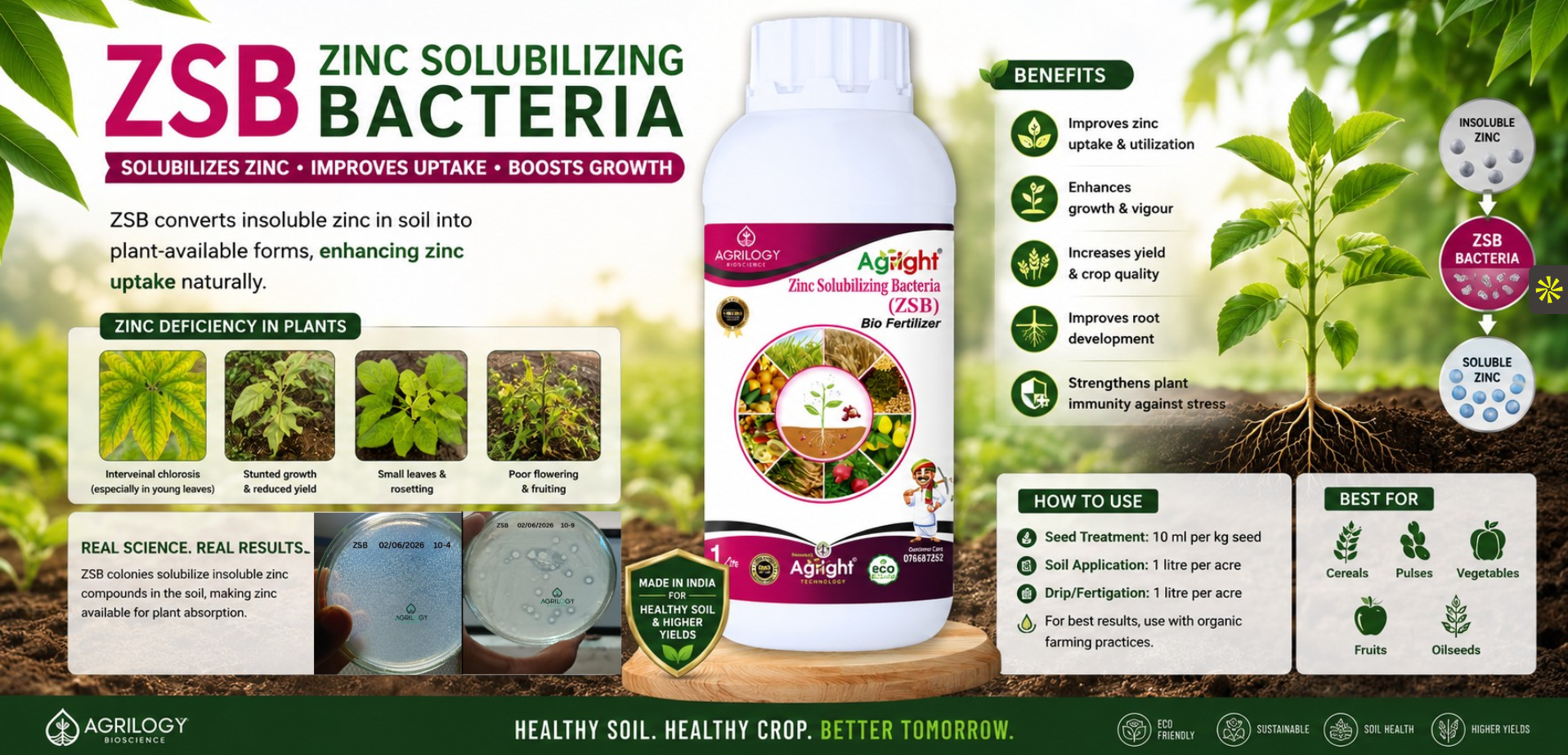
If you've ever wondered why your crops struggle despite adequate fertilization, the answer might be hiding in plain sight—in the soil itself. Zinc is an essential micronutrient for plants, playing a critical role in auxin metabolism, protein synthesis, chlorophyll production, and enzyme functions. Yet nearly 50% of the world's agricultural soils are zinc-deficient, and much of the zinc that is present remains "locked up" in forms plants cannot absorb.
Enter Zinc Solubilizing Bacteria (ZSB) —nature's microscopic miners. ZSB are soil bacteria that catalyze the solubilization of insoluble zinc compounds through a variety of biochemical mechanisms. And among them, Bacillus species stand out as some of the most efficient and versatile zinc solubilizers on the planet.
But how exactly do these tiny organisms perform their magic? Let's dive into the science behind Bacillus-mediated zinc solubilization.
The Zinc Problem: Why Plants Can't Access What's Already There
Zinc occurs in soil in various insoluble forms—zinc oxide (ZnO), zinc carbonate (ZnCO₃), and zinc phosphate {Zn₃(PO₄)₂}. These compounds are chemically stable, meaning zinc ions (Zn²⁺) remain tightly bound and unavailable for plant roots to absorb.
Plants can only take up zinc in its soluble, ionic form (Zn²⁺). When soils are alkaline or calcareous—conditions common in many agricultural regions—zinc becomes even more tightly bound. This creates a paradox: plenty of zinc exists in the soil, but crops are starving for it.
ZSB solve this problem by employing a sophisticated arsenal of biochemical mechanisms. The genus Bacillus is among the most prevalent and effective ZSB isolated from diverse soils worldwide.
Mechanism 1: Organic Acid Production — The Primary Pathway
The primary and most well-documented mechanism by which Bacillus species solubilize zinc is through the production of organic acids.
How It Works
When Bacillus bacteria encounter insoluble zinc compounds in their environment, they respond by secreting a cocktail of organic acids. These acids serve two critical functions:
- Direct acidification of the surrounding microenvironment—lowering the pH around the bacterial cells and the zinc compounds
- Chelation—the acids' organic molecules bind to zinc ions, forming soluble complexes
The drop in pH is the key. As the pH decreases, the chemical equilibrium shifts, and insoluble zinc compounds begin to dissolve, releasing bioavailable Zn²⁺ into the soil solution.
The Acid Arsenal of Bacillus
Different Bacillus species produce different organic acid profiles, but the results are consistently impressive:
- Bacillus safensis secretes high levels of gluconic, keto-gluconic, oxalic, citric, malonic, and tartaric acids
- Bacillus sp. ZM20 and Bacillus cereus produce significantly high concentrations of lactic and acetic acids, with formic, citric, succinic, isobutyric, and isovaleric acids detected as minor end-products
- Bacillus aryabhattai produces almost all types of organic acids, with production profiles varying according to the zinc mineral substrate
- Gluconic acid is particularly critical—one study found gluconic acid production by a ZSB strain reached 1884.7 ± 413.4 μgmL⁻¹, which was 35.3–69.7% greater than other isolates
Research confirms that organic acids—particularly gluconic acids—and the secretion of chelating components are key mechanisms for zinc solubilization.
Mechanism 2: Proton Extrusion — Pumping for Solubility
Beyond organic acid production, Bacillus species employ a second strategy: proton extrusion.
Bacteria actively pump protons (H⁺ ions) out of their cells and into the surrounding environment. This serves two purposes:
- It helps regulate the bacteria's internal pH (homeostasis)
- It acidifies the external environment, further contributing to zinc solubilization
When combined with organic acid production, proton extrusion creates a "one-two punch" that maximizes zinc release from insoluble compounds.
Mechanism 3: Siderophore Production — The Chelation Strategy
Siderophores are iron-chelating compounds that bacteria produce to scavenge iron from the environment. While their primary target is iron, research shows that siderophores also play a role in zinc solubilization.
How Siderophores Help?
Siderophores function through ligand-metal complexation—they bind to metal ions and form soluble complexes that plants can absorb. Bacillus species produce various siderophores that can chelate not only iron but also zinc, making it available for plant uptake.
While zinc solubilization is primarily driven by pH reduction and organic acid production, siderophore-mediated chelation provides an additional pathway for zinc mobilization.
Mechanism 4: The "Acid Tolerance" Advantage — Surviving to Serve
Here's where Bacillus truly distinguishes itself from many other bacteria: it doesn't just produce acid—it survives it.
Zinc solubilization creates an acidic environment. Many bacteria would be killed or inhibited by the very acids they produce. But Bacillus species have evolved sophisticated acid tolerance responses.
The Survival Toolkit
Research on Bacillus revealed that during zinc oxide solubilization, the bacterium activates multiple adaptive mechanisms:
- Cell wall reinforcement — strengthening the bacterial cell wall against acid damage
- Membrane permeability modulation — controlling what enters and leaves the cell
- Proton influx regulation — managing the flow of protons to prevent internal acidification
- Metabolic adjustments — shifting metabolic pathways to cope with stress
This is crucial. The enhanced zinc solubilization potential of a Bacillus strain comes not just from how much acid it produces, but from its ability to withstand the acidic conditions it creates. A bacterium that dies from its own acid production is useless; Bacillus thrives in the environment it creates.
Mechanism 5: Oxidoreductive Systems — Membrane-Bound Transformations
ZSB also employ oxidoreductive systems expressed on cell membranes to transform zinc compounds. These enzymatic reactions can convert insoluble zinc compounds into soluble forms through redox processes, further expanding the bacterium's toolkit for zinc mobilization.
Additionally, bacteria secrete chelated ligands—compounds that bind to zinc ions and keep them soluble in the soil solution. This complements the acidification and chelation mechanisms described above.
Mechanism 6: Beyond Zinc — The Plant Growth Bonus
Bacillus species don't stop at zinc solubilization. They provide a suite of additional benefits that make them invaluable partners for plant growth:
- Phytohormone production: Many Bacillus strains produce indole acetic acid (IAA) , a plant growth hormone that stimulates root development and overall plant growth
- Phosphorus solubilization: Some Bacillus strains can solubilize phosphorus alongside zinc, addressing two major nutrient deficiencies simultaneously
- Antibacterial agents: Bacillus species secrete compounds, including hydrogen cyanide (HCN), that protect plants from pathogenic bacteria
- Improved soil biology: Inoculation with Bacillus improves soil nutrient status and microbial populations, including N, P, K, Fe, and Zn.
The Proof Is in the Plants
The scientific evidence for Bacillus-mediated zinc solubilization is compelling:
- Co-inoculation of Bacillus strains improved N, P, K, Fe, and Zn by 26, 30, 29, 19, and 27%, respectively, in rice grains
- Co-inoculation also improved crude protein in rice grains by 27% compared to untreated controls
- Bacillus megaterium CHW-22 significantly increased zinc content in wheat straw and grains along with other nutrients (N, P, K, Fe, Cu, and Mn)
- ZSB strains Bacillus sp. D-7 demonstrated excellent Zn-solubilization efficiency of 254%
- In wheat, Bacillus inoculation combined with zinc fertilizer significantly enhanced growth, yield, nutrient content, and zinc biofortification
The research clearly demonstrates that Bacillus inoculants not only increase plant growth but also enhance yield and yield attributes.
The Takeaway: Nature's Precision Engineering
What appears like "magic" is actually a sophisticated, multi-mechanism biochemical process honed by millions of years of evolution. Bacillus species don't just "dissolve" zinc—they:
- Acidify their environment with organic acids
- Pump protons to enhance acidification
- Chelate zinc ions with siderophores and chelated ligands
- Transform zinc compounds through oxidoreductive systems on cell membranes
- Survive the acidic conditions they create through sophisticated acid tolerance responses
- Support plant growth through multiple additional pathways including phytohormone production
The result? Locked-up zinc becomes available zinc. Starving plants become thriving crops. And farmers gain a sustainable, cost-effective alternative to heavy chemical fertilizer applications.
What This Means for Your Farm
Understanding the science behind ZSB isn't just academic—it's practical. When you choose a Bacillus-based biofertilizer, you're not just adding bacteria to your soil. You're deploying a complete, self-sustaining zinc mobilization system that:
- Reduces dependence on chemical zinc fertilizers
- Improves crop yields and nutritional quality
- Enhances soil health and biological activity
- Contributes to addressing global zinc malnutrition
The science is clear. The Bacillus species in your biofertilizer aren't just "working"—they're performing a precisely orchestrated biochemical symphony, turning locked-up zinc into the life-giving nutrient your crops need.
Ready to put this science to work on your farm? Choose a high-quality Bacillus-based ZSB biofertilizer and watch the magic of microbiology transform your soil—and your harvest.
Have questions about how ZSB can work for your specific crop or soil type? Drop a comment below or reach out to our team of agronomy experts.
Comments (0)
No comments yet. Be the first to comment!
Search Blogs
Recent Blogs
The Biology of Water Activity
August 7, 2026
What the Green on Our Trays Is Really Telling Us
July 29, 2026
Leave a Comment