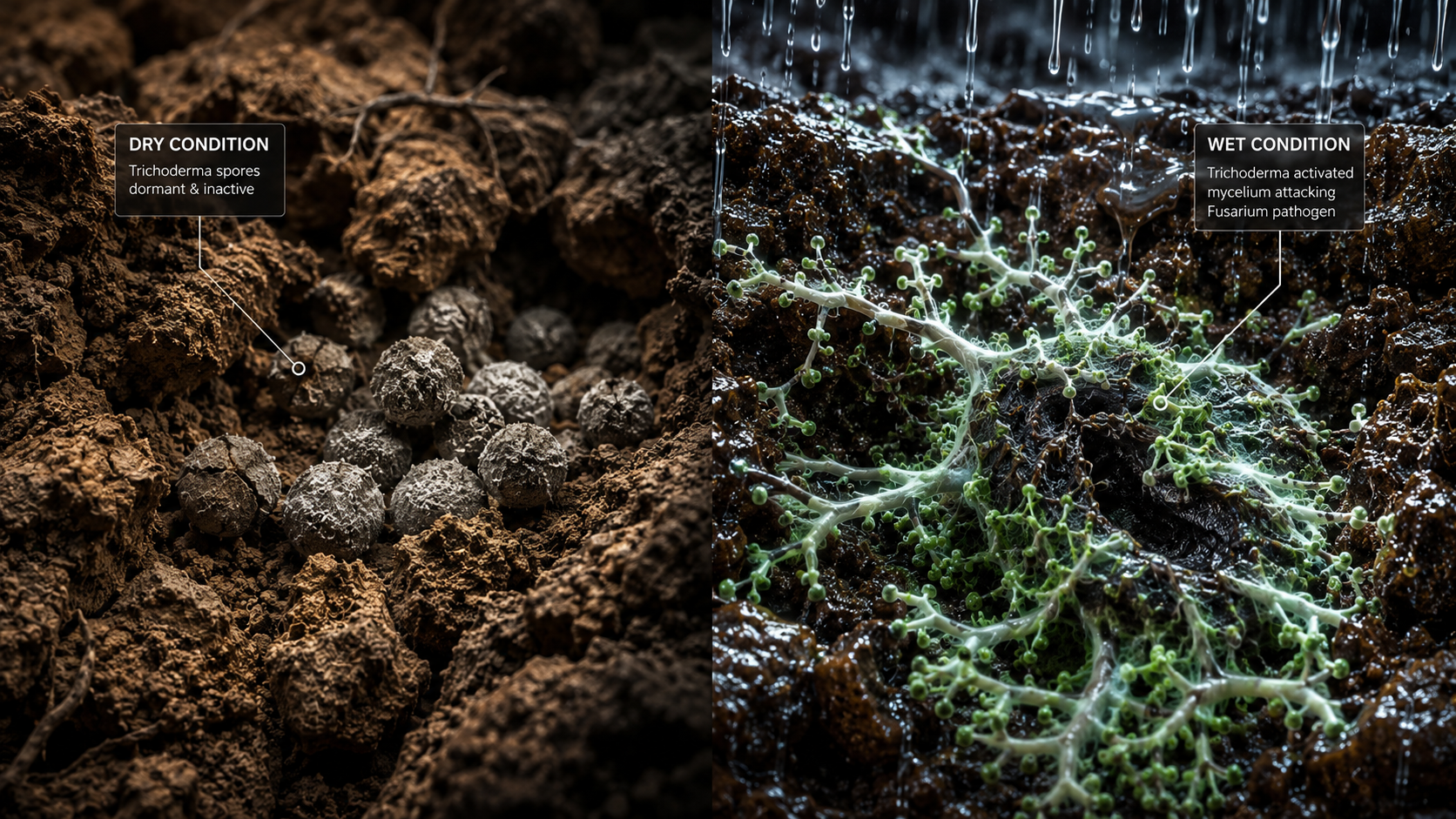


Why Your Bio-Agent is Sleeping for 8 Months—And Wakes Up Only Now
Look at your warehouse shelf right now. If you are stocking Trichoderma in December or peak summer, I can almost guarantee it is gathering dust. Farmers walk past it. They don't even ask for the price.
And you know what? They are absolutely right to ignore it.
Because for eight long months, that bio-agent is essentially asleep. Useless. Just expensive powder in a bag.
But suddenly—when the clouds roll in, or when the first pre-monsoon moisture hits the soil—your phone starts ringing off the hook. Everyone wants it. Distributors are fighting over stock. Farmers are asking for it by name.
What the hell happened? Did the product suddenly become magical overnight?
No. The environment just woke it up. And if you don't understand this sleep-wake cycle, you will keep losing money for eight months every single year.
Let me explain why it sleeps
Trichoderma is a living fungus. It is not a chemical. You cannot just throw it on dry, cold, or scorching soil and expect it to fight.
- Winter (Nov–Feb): Soil temperature drops below 18°C. The spores go into hibernation. They are alive, but they aren't multiplying or hunting pathogens. They are just... waiting.
- Summer peak (Apr–May): The ground is cracked and bone-dry. Even if you apply it, the spores have zero moisture to germinate. They lie dormant.
Farmers know this instinctively. They aren't biologists, but they know their land. They won't buy a product that can't even wake up in their field. So, for eight months, your bio-agent sleeps—and so does your sales graph.
Now, here is what finally kicks it awake
Two things need to happen simultaneously for Trichoderma to snap out of its slumber:
First, the rain or the spring thaw:
The moment soil moisture crosses a certain threshold and humidity goes above 80%, the spore senses it. It says, "Okay, conditions are safe now. Time to germinate."
Second, and more importantly—the bad guys wake up too
This is the cruel joke of nature. The same warm, wet conditions that wake up your Trichoderma are the exact same conditions that wake up the Fusarium, the Rhizoctonia, and the Pythium—the root-rotting monsters that destroy nurseries.
So, your bio-agent doesn't just wake up to stretch. It wakes up because there is a war waiting for it. And the farmer only needs it during that war. Not before. Not after.
But wait—there is another alarm clock: the sowing date
Your Trichoderma is lazy. It needs a root to cling to. It needs a seed or a young sapling to protect.
If there is no crop in the ground, the bio-agent has no food source and no purpose. That is why demand doesn't just spike with the rain—it spikes specifically in the two-week window before sowing.
Farmers think: "My seed is going in next Tuesday. I need protection right now." That is the only time they open their wallets. If you try to sell it to them a month later, after the seeds have already germinated? They will laugh at you and walk away.
And here is the ugly truth about your storage
Why does it sleep for eight months in your godown specifically? Because you are probably keeping it in a hot tin shed.
Trichoderma is fragile. Every month it sits on your shelf at 35–40°C, the spore count (CFU) drops. By the time the season actually arrives, your "fresh stock" from six months ago is half-dead.
Farmers have been burned before. They know that old stock doesn't work. That is why they refuse to buy bio-agents in the off-season, even if you offer a heavy discount. They are waiting for the fresh batch that comes straight out of the fermentation unit 60 days before the rains.
The entire supply chain runs on this panic mode—manufacturers rush production, distributors scramble for fresh lots, and retailers sell it all within six weeks. Then it goes back to sleep for another eight months.
So, what is the takeaway for you?
Stop fighting the calendar. You cannot force a living organism to work in the wrong season.
- Use the off-season to educate, not to sell. Tell your farmers: "Book your fresh stock now, I will deliver it exactly when the soil is ready."
- Check your cold storage. If you have space, keep your stock at 15–20°C to prolong its life.
- Stop discounting old inventory in the dead months. You are just devaluing your product. Instead, wait for the window—and sell it at full value when the crop actually needs it.
The bio-agent sleeps for eight months because nature designed it that way. Your job is not to wake it up early. Your job is to be fully stocked and ready the moment the rain taps on the farmer's roof.
Because when it wakes up, it wakes up angry—and ready to fight. And that is exactly when your farmer will come running to you.